
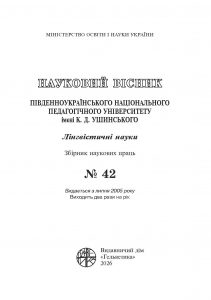
«Scientific Research Issues of South Ukrainian National Pedagogical University named after K. D. Ushynsky: Linguistic Sciences» has been published by South Ukrainian National Pedagogical University named after K. D. Ushynsky since 2005. Certificate of state registration of print media: Series КВ 24068-13908ПР (31. 07. 2019).
 Typology in lexical semantics: sources of meaning ʻignorantʼ
Alexander I. Iliadi
DOI: https://doi.org/10.24195/2616-5317-2026-42.1
You can’t bring him here for love or money: on the symbolics of kalach in Slavic phraseology
Natalia G. Arefieva
DOI: https://doi.org/10.24195/2616-5317-2026-42.2
Evelina V. Boieva, Viktoriia O. Bieliaievska
DOI: https://doi.org/10.24195/2616-5317-2026-42.3
Olga O. Bychkova
DOI: https://doi.org/10.24195/2616-5317-2026-42.4
Structural-semantical transformations of phraseological units in modern Ukrainian women's prose
Viktoriia V. Dashkova
DOI: https://doi.org/10.24195/2616-5317-2026-42.5
Linguostylistic characteristics of the english-language official educational blog
Angelina I. Demchuk, Iryna O. Lukyanchenko
DOI: https://doi.org/10.24195/2616-5317-2026-42.6
English prefixed verbs: meanings and senses
Anna Dudok
DOI: https://doi.org/10.24195/2616-5317-2026-42.7
Halyna Ie. Fateh
DOI: https://doi.org/10.24195/2616-5317-2026-42.8
The impact of word order and actual division on learning languages of diverse families and groups
Jelalatdin N. Garlyyev
DOI: https://doi.org/10.24195/2616-5317-2026-42.9
Specifics of translating neologisms in contemporary German
Maksym Hnidets, Oksana Zubach
DOI: https://doi.org/10.24195/2616-5317-2026-42.10
Axiological vocabulary in English-language public discourse
Alla A. Ishchuk, Olena M. Ishchuk
DOI: https://doi.org/10.24195/2616-5317-2026-42.11
The phonetic-phonological system of the Ukrainian language in historical discourse
Halyna V. Kocherha
DOI: https://doi.org/10.24195/2616-5317-2026-42.12
The productive potential of the term ‘mobile communication’
Khrystyna Kovalchyk
DOI: https://doi.org/10.24195/2616-5317-2026-42.13
Luo Sicheng
DOI: https://doi.org/10.24195/2616-5317-2026-42.14
Linguostylistic features of us presidents’ speeches
Lesia K. Malimon, Olha I. Horokhova
DOI: https://doi.org/10.24195/2616-5317-2026-42.15
Nataliia G. Moiseienko
DOI: https://doi.org/10.24195/2616-5317-2026-42.16
Oleksandra S. Palchevska, Petro Hubych, Alina Prus
DOI: https://doi.org/10.24195/2616-5317-2026-42.17
Terms formation in the English-language computer terminology system: semantic aspect
Kyrylo S. Plotkin, Ilona M. Derik, Nataliya L. Korolyova
DOI: https://doi.org/10.24195/2616-5317-2026-42.18
Oleksandra V. Popova
DOI: https://doi.org/10.24195/2616-5317-2026-42.19
Tetiana V. Pryshchepa
DOI: https://doi.org/10.24195/2616-5317-2026-42.20
Ievgenii N. Stepanov
DOI: https://doi.org/10.24195/2616-5317-2026-42.21
Oleh V. Tyshchenko, Maryna Kucherenko
DOI: https://doi.org/10.24195/2616-5317-2026-42.22
Iryna Vorchakova
DOI: https://doi.org/10.24195/2616-5317-2026-42.23
Tetiana O. Yasynska, Anna O. Ishchenko
DOI: https://doi.org/10.24195/2616-5317-2026-42.24
Viktoriia M. Yushak, Liudmyla V. Kovalchuk, Larysa M. Kyrychuk