Skip to content


pdfNatalya Zhmayeva

Candidate of Philology, Associate Professor at the Department of Translation and Theoretical and Applied Linguistics, State Institution “South Ukrainian National Pedagogical University named after K. D. Ushynsky”
Odesa, Ukraine
e-mail: zhmaeva@gmail.com
ORCID ID: https://orcid.org/0000–0003–3382–0155

DOI:https://doi.org/10.24195/2616-5317-2022-34-3


Key words: political speeches, strategy of communicatively equivalent translation, strategy of tertiary translation, translation tactic, translation operation.


SUMMARY

Modern translation studies which are of descriptive nature mainly presuppose the opportunity of altering the function of the source text in translation, reconstruction of sense and structure in correspondence with the aim of translation. The investigation has been carried out in the framework of the communicativefunctional approach to translation which accounts for the entire spectrum of linguistic and extra linguistic factors influencing translation in the broad sense. This fact proves the relevance of the article.

The carried out analysis is aimed at determining the inventory of tactics and operations of the translations resulted from applying the strategy of communicatively equivalent translation and the strategy of tertiary translation.

The implemented strategies of translation have been actualized by common tactics (the tactic of rendering relevant information, the tactic of rendering stylistic features, the tactic of rendering the source text formal and structural features), each having specific features of realization.

Common operations for the applied tactics have proved to be as following: search for an equivalent or a variant equivalent,


REFERENCES

Zhmayeva, N. S., Korolova, T. M. (2018). Stratehii, taktyky ta operatsii perekladu [Translation Strategies, Tactics and Operations]. Proceedings of XX International scientific conference «Practical Applications of Research Findings 2018». Morrisville: Lulu Press, 60–63. [in Ukrainian]

Washington’s Farewell Address to the People of the United States. https://www.govinfo. gov/content/pkg/GPO-CDOC-106sdoc21/pdf/GPO-CDOC-106sdoc21.pdf

President John F. Kennedy’s Inaugural Address. https://www.archives.gov/milestonedocuments/president-john-f-kennedys-inaugural-address

Zhmayeva, N. S., & Yukhymets, S. Yu. (2019). Do pytannia vyznachennia kryteriiv otsiniuvannia adekvatnosti perekladu [On the issue of translation adequacy assessment criteria]. PNPU imeni K. D. Ushynskoho: zb. nauk. prats (linhvistychni nauky), 29, 104–119 [in Ukrainian


pdfIlona Derik

Candidate of Philological Sciences, Associate Professor, Associate Professor of the Department of Translation and Theoretical and Applied Linguistics, State Institution
“South Ukrainian National Pedagogical University named after K. D. Ushinsky”
Odesa, Ukraine
e-mail: ilonaderik@gmail.com
ORCID ID: https://orcid.org/0000–0002–8979–4745
Researcher ID: AAJ-3411–2020

DOI:https://doi.org/10.24195/2616-5317-2022-34-2


Key words: discourse, penitentiary texts, concretization, generalization, modulation, grammatical transformation, legislation.


RESUME

The article is devoted to the study of the peculiarities of the English penitentiary discourse rendering in Ukrainian translation. The urgency of the work is due to the urgent need for a comprehensive study of penitentiary texts. The objective of the research is to outline the peculiarities of penitentiary discourse, the study of different approaches to the interpretation of this phenomenon and the formulation of the key rules of translating English penitentiary discourse into Ukrainian. This resulted in the following tasks: to clear out the notion of discourse in linguistics and its specificity; to characterize the structural features of penitentiary discourse; to study the peculiarities of terms in penitentiary discourse and to analyze translation transformations employed in rendering English penitentiary discourse in Ukrainian.The comprehensive approach to the research allowed to enlarge and extend the scope of the terminological lexes, to reveal the linguistic means of penitentiary discourse realization as well as strategies, techniques and transformations employed in rendering English penitentiary texts in Ukrainian translation. As for the lexical transformations employed, their distribution may be characterized as follows. Loan translation was used in 25 cases or 12,5 %, transliteration in 22 cases or 11,0 %, lexico-semantic replacements in 69 cases or 34,5 %, concretization in 27 cases or 13,5 %, generalization in 16 cases or 7,0 %, modulation in 23 cases or 11,5 %. As for the grammatical transformations employed, their distribution may be characterized as follows. Grammatical replacements occur in 9 cases or 4,5 %, transpositions in 8 cases or 4,0 %, the null translation or omission in 3 units or 1,5 %. The practical value of the article and its efficiency may be grounded by a great demand for the qualified study of such issues as the speech of legislation and execution. The perspective may be seen in the compilation of a thesaurus or glossary of penitentiary terms. 


REFERENCES

Zinchenko, S. (2017). Formuvannia povnotsinnoi systemy pidhotovky penitentsiarnoho personalu — holovna umova praktychnykh zmin u Derzhavnii penetentsiarnii sluzhbi Ukrainy [Elektronnyi resurs]. Elektron. tekst. dani. Rezhym dostupu : http:// www.minjust.gov.ua

Inshyn, M., Shopina, I., Yakymov, H. (2008) Slovnyk zakonodavchykh i normatyvnykh
terminiv. Кyiv. 487.

Pro zatverdzhennia Kontseptsii derzhavnoi systemy profesiinoi oriientatsii naselennia : zatv. postanovoiu Kabinetu ministriv Ukrainy vid 17 veres. 2008 r., № 842. Elektronnyi resurs. Rezhym dostupu : http:// zakon.rada.gov.ua / laws /show

Ptashynskyi, О. Pravovi problemy reformuvannia penitentsiarnoi systemy v Ukraini. Кyiv.18.

Yagunov, D. (2011). Derzhavna penitentsiarna sluzhba Ukrainy: deiaki pytannia kontseptualnoho ta terminologichnoho obhruntuvannia, Aktualni problemy derzhanoho upravlinnia. Odesa. Volume 3 (47). 252.

World Prison Brief Data. Elektronnyi resurs. Rezhym dostupu: http://prisonstudies.org/ world-prison-brief-data


pdfVolodymyr Glushchenko

Doctor of Science (Linguistics), Professor, Head of the Department
of Germanic and Slavonic Linguistics,
Donbas State Teachers’ Training University
Sloviansk, Ukraine
e-mail: sdpunauka@ukr.net
ORCID ID: https://orcid.org/0000–0002–2394–4966

DOI:https://doi.org/10.24195/2616-5317-2022-34-1


Key words: P. Lavrovskyi, ancient manuscripts, chronicles, reduced vowels, decline of the reduced vowels, the Common Slavonic language, the Old Russian language, the Eastern Slavonic languages.


SUMMARY

In the 50’s of the XIX century Peter Lavrovskyi (1827–1886), a prominent Slavic philologist and educator, published a number of works on the ancient Russian (Proto-East Slavic) language and its dialects. Among these studies, which have retained their scientific significance to our time, the book «On the language of northern Russian chronicles» (1852) should be mentioned, in which P. Lavrovskyi, basing on ancient East Slavic manuscripts, studied in detail the nature, origin and history of reduced vowels [ъ], [ь] on the East Slavic territory. Ancient manuscripts were a priority source for the study of the reduced for P. Lavrovskyi: chronicles, deeds, treaties, acts. At the same time, the scientist used the material of his contemporary Slavic languages, primarily East Slavic, as an auxiliary source

As well as A. Vostokov and І. Sreznevskyi, P. Lavrovskyi regarded [ъ], [ь] as Common Slavonic heritage in the Old Russian language. P. Lavrovskyi thought that А. Vostokov used improper term «semivowels». He found it necessary to call [ъ], [ь] vowel sounds. P. Lavrovskyi proved that G. Pavskyi speaking about «breathed sounds» in fact defend the consonant nature of [ъ] and [ь]. However, the discrepancy of G. Рavskyi’s treatment of [ъ], [ь] doesn’t end with it. G. Pavskyi further writes that, [ъ] and [ь] in the most ancient Cyrillic texts were used for defining hardness and softness of the consonant sounds as well as for substitution of vowels that fall together. P. Lavrovskyi stressed that here the insensibility of meanings of the letters ъ, ь in the Old Russian and the Modern Russian languages can be traced. P. Lavrovskyi paid a great attention to the origin of the sounds [ъ], [ь]. P. Lavrovskyi stated that Common Slavonic [ъ], originated from Proto-Indo-European short [u], and Common Slavonic [ь] — from Proto-IndoEuropean short [i]. So P. Lavrovskyi gave the most overall for its time record of Old Russian [ъ], [ь] from the point of their nature and origin.

P. Lavrovsky’s contribution to the study of the East Slavic process of the decline of the reduced, which consisted in the transition [ъ], [ь] to [o], [e] in the strong position and the disappearance of [ъ], [ь] in the weak position, is significant.. 


REFERENCES

Vostokov, А. Kh. (1865). Rassuzhdeniye о slavyanskom yazyke, sluzhashcheye vvedeniyem k grammatike segо yazykа, sostavlyayemoy pо drevneyshim оnogо pismennym pamyatnikam. [Discourse about the Slavic language, which serves as an introduction to the grammar of this language, compiled from the oldest manuscripts]. Vostokov А. Kh. Filologicheskiye nablyudeniya. Sankt-Peterburg, рр. 1–27. [in Russian]

Glushchenko, V. A. (2017а). Henezys i evoliutsiia redukovanykh holosnykh skhidnoslovianskykh mov u kontseptsii P. O. Lavrovskoho. [Genesis and evolution of reduced vowel East Slavic languages in the concept of P. O. Lavrovskyi]. Naukovi pratsi Kamianets-Podilskoho natsionalnoho universytetu imeni Ivana Ohiienka: filolohichni nauky. Kamianets-Podilskyi: Aksioma. Vyp. 44, рр. 87–90. [in Ukrainian]

Glushchenko, V. A. (2017b). Istoriia slovianskykh «hlukhykh» holosnykh u kontseptsii P. O. Lavrovskoho. [The history of Slavic voiceless vowels in the concept of P. O. Lavrovskyi]. Slovianskyi zbirnyk: zb. nauk. prats. Chernivtsi: Bukrek. Vyp. 21, рр. 9–23. [in Ukrainian]

Glushchenko, V. A. (2019). Istoriia skhidnoslovianskykh [Ъ], [Ь] u kontseptsii Р. О. Lavrovskohо. [History of East Slavic [Ъ] [Ь] in the concept of P. O. Lavrovskyi]. Petro
Oleksiiovych Lavrovskyi: naukova i naukovo-krytychna spadshchyna (do 190-richchia vid dnia narodzhennia): zb. nauk. prats. Kyiv: Vydavnychyi dim Dmytra Buraho, рр. 57–62. [in Ukrainian]

Glushchenko, V. A. (2016). P. O. Lavrovskyi pro pryrodu y pokhodzhennia redukovanykh holosnykh. [P. O. Lavrovskyi on the nature and origin of reduced vowels]. Naukovyi visnyk Natsionalnoho universytetu bioresursiv i pryrodokorystuvannia Ukrainy. Filolohichni nauky. Kyiv: Milenium. Vyp. 248, рр. 14–20. [in Ukrainian]

Glushchenko, V. A. (1998). Pryntsypy porivnialno-istorychnoho doslidzhennia v ukrainskomu i rosiiskomu movoznavstvi (70-i rr. ХІХ st. — 20-i rr. ХХ st.) [Principles of Comparative-Historic Researches in Ukrainian and Russian Linguistics (70-s XIX ct. — 20-s XX ct.)]. Donetsk. [in Ukrainian]

Zhykharieva, О. L. (2001) P. О. Lаvrоvskii і putannia pоkhоdzhennia skhіdnоslоvianskykh mov. [P. O. Lavrovskyi and the question of the origin of East Slavic languages]. Teorеtichеskiyе i prikladnyyе prоblemy russkoy filologii. Slаvyansk. Vyip. ІХ. Ch. 1, рр. 31–36. [in Ukrainian]

Kolesov, V. V. (1985). Comparative historical method in the works of А. А. Potebnya.
[Comparative-historical method in the works of A. A. Potebnya]. Naukova spadshchyna О. О. Potebni i suchasna filolohiia. Do 150-richchia z dnia narodzhennia О. О. Potebni: zb. nauk. prats. Kyiv: Naukova dumka, рр. 25–39. [in Russian] A. A. Potebnya

Lаvrovskiy, P. А. (1852). О yazykе sеvеrnykh russkikh lеtоpisey. [On the language of northern Russian chronicles]. Sаnkt-Peterburg. [in Russian] Маksimovich, М. А. (1880). Nachatki russkoy filologii: оb оtnoshenii russkoy rechi k zapadnoslavyanskoy. [The beginnings of Russian philology: the relation of the Russian language to the West Slavic]. Маksimovich М. А. Sоbrаniye sоchineniy. Kiyev. Т. 3, рр. 25–155. [in Russian]

Pаvskiy, G. P. (1850). Filologicheskiye nablyudeniya nad sostavom russkogo yazykа: pervoye rassuzhdeniye. О bukvakh i slogakh. [Philological observations on the composition of the Russian language: the first discourse. Аbout letters and syllables]. 2-е izd. Sаnkt-Peterburg. [in Russian]

Sreznevskiy, I. I. (1959). Mysli оb istorii russkogo yazykа. [Thoughts on the history of the Russian language]. Мoskva: Uchpedgiz, рр. 16–81. [in Russian]

ISSN: 2664-2662
Linking ISSN (ISSN-L): 2616-5317

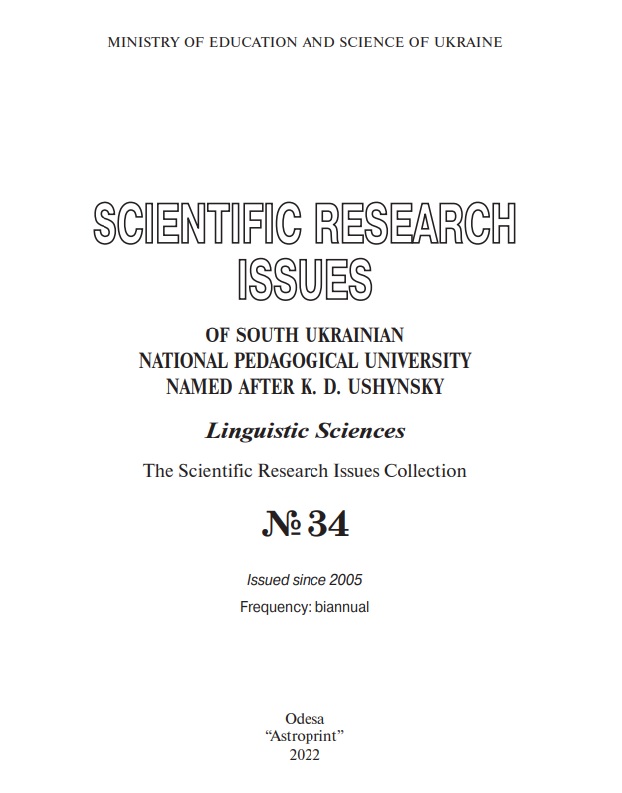
«Scientific Research Issues of South Ukrainian National Pedagogical University named after K. D. Ushynsky: Linguistic Sciences» has been published by South Ukrainian National Pedagogical University named after K. D. Ushynsky since 2005. Certificate of state registration of print media: Series КВ 24068-13908ПР (31. 07. 2019).


Full Issue  pdf


Content


pdfANCIENT CHRONICLES AS A SOURCE FOR STUDYING THE HISTORY OF THE REDUCED VOWELS IN THE WORK OF P. LAVROVSKYI «ON THE LANGUAGE OF NOTHERN RUSSIAN CHRONICLES»

Volodymyr Glushchenko

DOI:https://doi.org/10.24195/2616-5317-2022-34-1


pdfON THE PECULIARITIES OF THE ENGLISH PENITENTIARY DISCOURSE RENDERING IN UKRAINIAN TRANSLATION

Ilona Derik

DOI:https://doi.org/10.24195/2616-5317-2022-34-2


pdfON THE ISSUE OF TRANSLATION STRATEGIES OF POLITICAL SPEECHES

Natalya Zhmayeva

DOI:https://doi.org/10.24195/2616-5317-2022-34-3


pdfLEXICAL EXPLICATION OF THE CONCEPT «POWER» IN OLD ENGLISH (LEXICAL AND-SEMANTIC STUDIES)

Alexander I. Iliadi, Anastasiia A. Fedorova

DOI:https://doi.org/10.24195/2616-5317-2022-34-4


pdfSOME PECULIARITIES OF SOCIOLINGUAL SYSTEM DEVELOPMENT IN YOUTH COMMUNICATIVE BEHAVIOR

Tetiana Korolova, Olga Aleksandrova

DOI:https://doi.org/10.24195/2616-5317-2022-34-5


pdfECONOMIC AND LEGAL DISCOURSE: PARADIGM OF CHANGES IN THE XXI CENTURY (ON THE MATERIAL OF CHINESE, ENGLISH AND UKRAINIAN LANGUAGES)

Oleksandra Popova

DOI:https://doi.org/10.24195/2616-5317-2022-34-6


pdfCOGNITIVE ASPECTS OF THE CONFUCIUS WORLDVIEW (BASED ON THE «LUN YU»)

Yuliia Stoianova

DOI:https://doi.org/10.24195/2616-5317-2022-34-7


pdfFEATURES OF CULINARY DISCOURSE TRANSLATION

Tetiana Stoianova, Victoria Shutyak

DOI:https://doi.org/10.24195/2616-5317-2022-34-8


pdfTHE CHARACTERISTIC FEATURES OF MULTIMEDIA DISCOURSE AS A TYPE OF MEDIA DISCOURSE

Inna Stupak, Anastasiya Shalamay

DOI:https://doi.org/10.24195/2616-5317-2022-34-9


pdfMODERN ENGLISH INTERNET DISCOURSE

Oksana Chernysh

DOI:https://doi.org/10.24195/2616-5317-2022-34-10


pdfRENDERING LINGUISTIC AND CULTURAL REALIA IN UKRAINIAN TRANSLATION OF ENGLISH ALLUSIONS

Anastasiia Yumrukuz, Juliana Irkhina

DOI:https://doi.org/10.24195/2616-5317-2022-34-11


pdfTHE SPECIFICITY OF PHRASAL VERBS USAGE IN THE ENGLISH LEXICOLOGY CLASSES

Tetyana Yablonska

DOI:https://doi.org/10.24195/2616-5317-2022-34-12


pdfALGORITHM FOR FORMING SIMPLE INTEROGATIVES IN THE PROCESS OF DIALOGICAL SPEECH IN THE ENGLISH LANGUAGE

Liudmyla Yavorska

DOI:https://doi.org/10.24195/2616-5317-2022-34-13